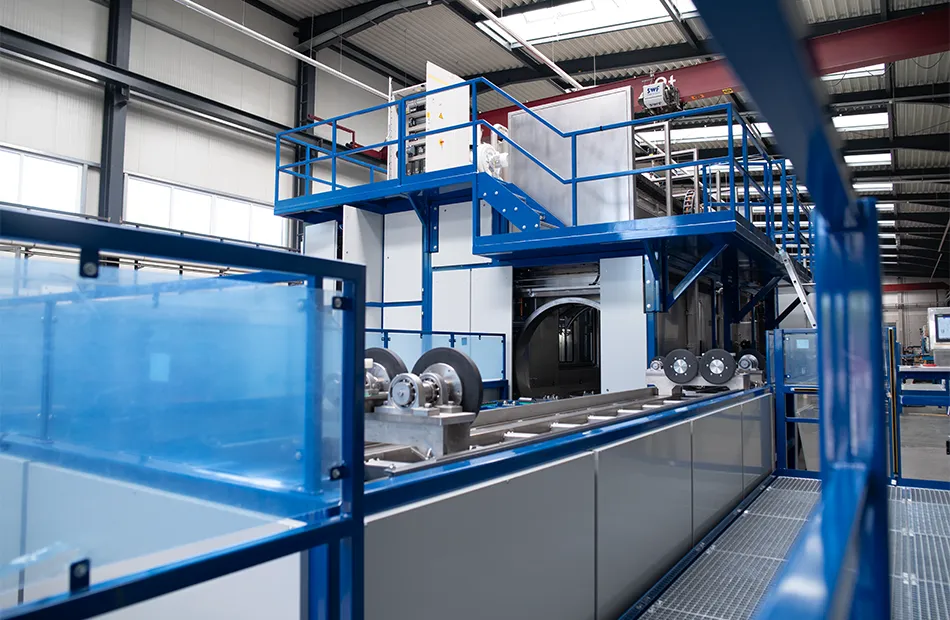
The range of parts to be cleaned comprised intricately shaped stamped and drawn parts with complex recesses, edges and blind holes, most of which were heavily contaminated with oil and particulate residues. In addition to outstanding degreasing performance, the system was required to ensure a consistently low level of residual contamination – comparable to the results achieved by vapic’s in-house contract cleaning service.
A further key requirement was adaptation to a two-shift production environment with an automatically fed material flow. At the same time, the aim was to significantly reduce energy consumption and to carry out the processes entirely in a closed vacuum system to prevent emissions. This led to the vision of a robust, compact and low-emission cleaning system, optimised for mesh box sizes and energy-efficient multi-shift operation.
The manufacturing process for stamped and deep-drawn parts produces complex geometries featuring deep recesses, bores and overlaps, in which machining oils and particles become trapped.
Existing cleaning systems quickly reached their limits when dealing with these geometries and part weights: residues remained in blind holes, and long drying times caused bottlenecks in the material flow. At the same time, energy consumption needed to be significantly reduced compared with conventional solvent-based systems.
What was required, therefore, was a high-performance, low-emission and energy-efficient solvent cleaning system capable of reliably degreasing entire mesh crates – with consistently high cleaning quality and automated logistics integration.
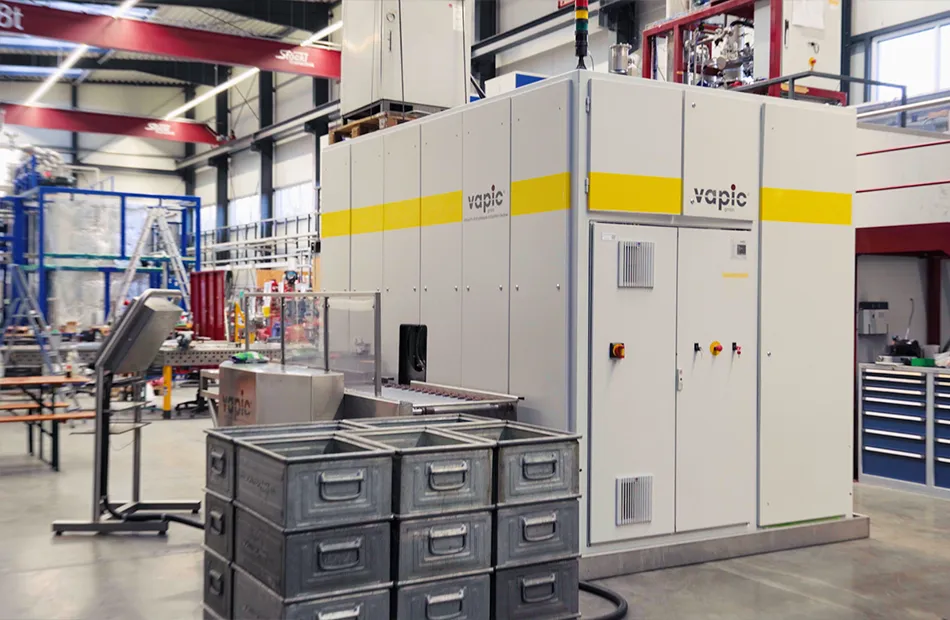
For this task, vapic designed a vacuum-resistant solvent system based on perchloroethylene, sized to accommodate pallet dimensions of 1200 × 800 × 1000 mm.
The combined pressure-switching and superheated steam degreasing process alternately raises the medium to boiling point and then condenses it again – ensuring that even narrow crevices and blind spots are thoroughly flushed. At the same time, full-flow filtration takes place via high-performance filter elements down to 1 µm to permanently prevent particle residues.
The vacuum drying process with an integrated heat recovery system guarantees short process times with minimal energy consumption.
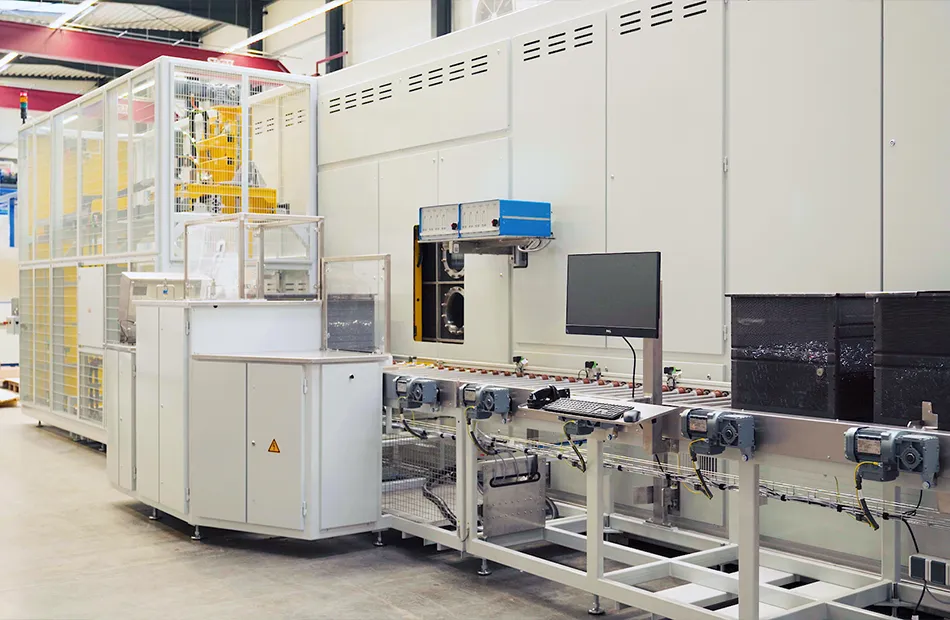
An automatic shuttle loading system handles the loading, unloading and temporary storage of the mesh boxes across eight stations – seamlessly integrated into the existing material flow.
Thanks to the vapic process, customers can now achieve consistently clean and stain-free components, even with complex geometries. Cycle times have been reduced by up to 50 per cent, whilst energy consumption has fallen by around 70 per cent compared with comparable PER systems.
Thanks to sealed vacuum technology, the system operates virtually emission-free and complies with all safety and environmental requirements of the 2nd BImSchV.
The system impresses with stable process conditions, low operating costs and high system availability, leading to a significant improvement in quality, cost-effectiveness and sustainability in parts production
Jede vapic Reinigungsanlage ist eine maßgeschneiderte Sonderanfertigung. In unseren Projektbeispielen zeigen wir, wie wir individuelle Anforderungen aus Industrie und Fertigung in leistungsfähige, effiziente Reinigungslösungen umsetzen.